What Is Squad Depth in Football? How to Visualise Your Full Squad
Learn what squad depth means in football, why it matters, and how to visualise your full squad by position, availability and formation.
Published · Updated

What Is Squad Depth in Football? How to Visualise Your Full Squad
A football team is much more than its starting XI.
Across a full season, injuries, suspensions, fixture congestion, changes in form and tactical adjustments can all force a manager to look beyond the first-choice lineup.
That is where squad depth becomes important.
Understanding your squad depth means knowing not only who your best players are, but also which players can cover each position, where your alternatives are limited, and how the squad changes when certain players are unavailable.
Visualising that information can make the structure of a squad much easier to understand.
What Does Squad Depth Mean in Football?
Squad depth refers to the number and quality of options a team has available beyond its preferred starting XI.
A team might have an excellent first-choice left winger, for example, but still have poor depth in that position if there is no reliable alternative.
Good squad depth usually means having multiple realistic options across most positions.
It can also include players who are capable of covering several positions.
This becomes especially important during a long season, when the same starting eleven cannot realistically play every match.
Squad Depth Is More Than Squad Size
Having a large squad does not automatically mean having good squad depth.
Imagine a team with six central midfielders but only one natural left-back.
The squad may contain plenty of players overall, but its positional depth is unbalanced.
A useful way to evaluate a squad is therefore to look at it position by position.
For example:
- Goalkeeper
- Right-back
- Centre-back
- Left-back
- Defensive midfield
- Central midfield
- Attacking midfield
- Right wing
- Left wing
- Striker
For each position, you can then identify the first choice, backup options and emergency cover.
This gives a much clearer picture than simply looking at a list of player names.
Why Squad Depth Matters
Injuries and suspensions
A player can become unavailable at any point during the season.
If you already know who can replace them, it is much easier to understand how the team might change.
The problem becomes especially obvious when multiple players in the same area of the pitch are unavailable at the same time.
Fixture congestion
Teams competing across multiple competitions can play frequently over short periods.
Rotation becomes necessary, which means the quality of the second and third options in each position matters.
Tactical flexibility
Different opponents may require different formations or player profiles.
One match might suit a 4-3-3, while another could call for a 4-2-3-1 or a back three.
A squad with several positional options gives you more ways to change the team without completely rebuilding it.
Transfers and recruitment
Visualising the entire squad can also reveal where reinforcements are actually needed.
Instead of simply thinking, “we need another midfielder”, you can identify something more specific:
“We only have one reliable defensive midfielder.”
That makes gaps in the squad much easier to spot.
How to Create a Football Squad Depth Chart
One of the simplest ways to understand squad depth is to create a visual depth chart.
Start with your preferred formation.
For example, in a 4-3-3:
- GK
- RB
- RCB
- LCB
- LB
- DM
- RCM
- LCM
- RW
- LW
- ST
Then place your preferred starter in each position.
Under each starter, add the other players who can realistically play that role.
You now have a basic football squad depth chart.
Instead of viewing 20 or 25 player names as one long list, you can immediately see how many options exist in each area of the pitch.
Add Player Availability to Your Squad View
Squad depth becomes even more useful when player availability is included.
For example, players could be categorised as:
- Available
- Injured
- Suspended
- Doubtful
- Unavailable
- Other custom statuses
This means a position that normally looks well covered may suddenly appear much weaker.
Suppose you have three centre-backs.
On paper, that looks reasonable.
But if one is injured and another is suspended, your practical squad depth for the next match is very different.
Combining positional depth with player status gives you a more realistic picture of the squad at a specific moment.
Formation View vs Full-Squad View
There are two useful ways to visualise a football squad.
Formation view
A formation-based view places players on a football pitch.
This is useful when you want to understand:
- Your preferred starting XI
- Backup players for each position
- How the squad fits a specific formation
- Alternative lineups
- Positional competition
It answers the question:
Who plays where?
Full-squad view
A broader grid or squad overview can be useful when you want to see every player at once.
This is especially useful for:
- Player availability
- Injuries
- Suspensions
- Squad categories
- Position groups
- General squad planning
It answers the question:
What does the entire squad currently look like?
The two views complement each other.
A formation tells you how players fit into a system, while a wider squad view helps you understand the overall state of the team.
Visualise Your Squad with Squad Anytime
Squad Anytime is a football squad visualisation app for iPhone and Android designed for people who want to organise and explore a squad visually.
You can use Formation View to arrange players by position and see how the squad fits into different formations.
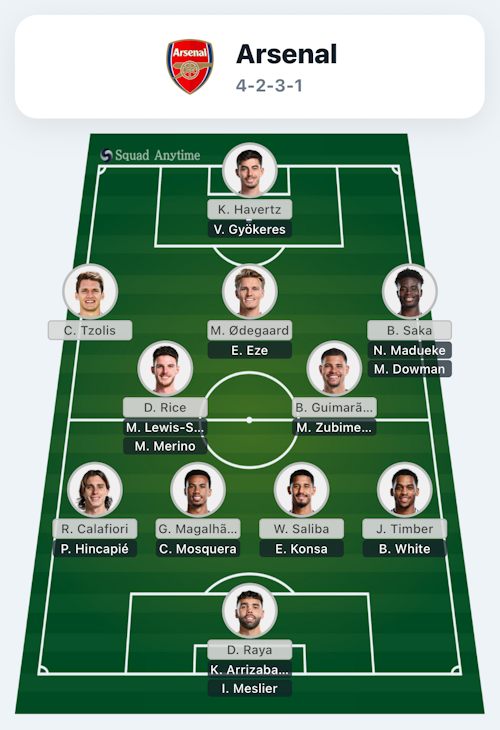
You can also use Grid View to see the wider squad and distinguish players using visual status information, such as whether they are available, injured or otherwise unavailable.
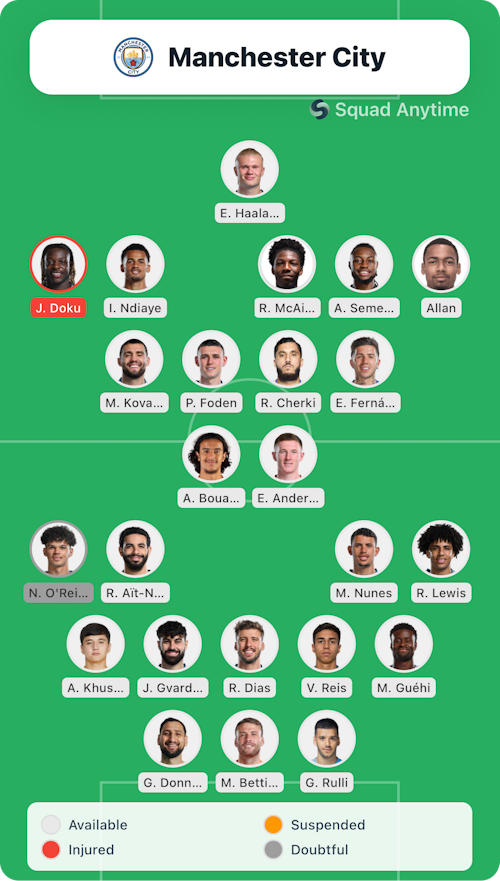
Instead of keeping squad ideas across notes, screenshots or spreadsheets, you can keep the structure of the team visible in one place.
A Better Way to Think About Your Squad
The starting XI is only one version of a football team.
Looking at the full squad helps answer much more interesting questions:
- Who replaces each starter?
- Which positions have the strongest depth?
- Where is there only one reliable option?
- Which injuries cause the biggest problem?
- How does the squad look in another formation?
- Where might another signing be needed?
Once the squad is visualised, those questions become much easier to answer.
And that is ultimately what squad depth is about: understanding not just your best eleven, but all of the options behind them.