How to Build and Compare Football Formations
Learn how to build football formations, compare different systems, place players by role, and see how your full squad fits each shape.
Published · Updated

A football formation is more than a set of numbers.
A 4-3-3, 4-2-3-1 or 3-5-2 only tells you the basic shape of a team. The more useful question is how your actual players fit into that shape — and what changes when you switch to another formation.
Building your squad visually can help you compare systems, understand positional competition and see which formations make the best use of the players available.
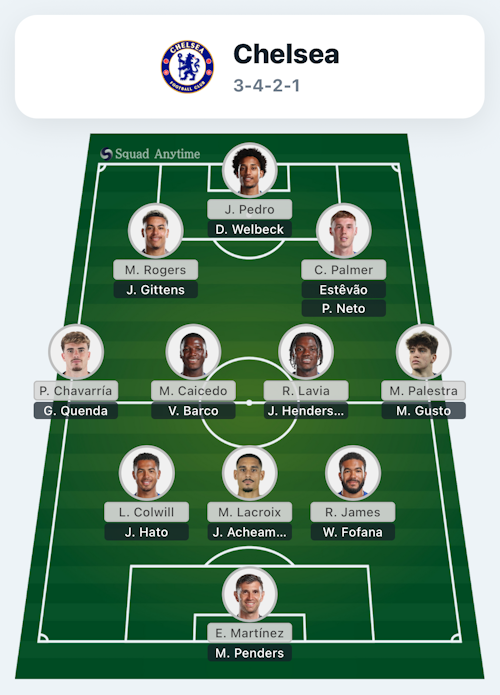
What Is a Football Formation Builder?
A football formation builder is a tool used to place players into positions on a football pitch.
Most formation builders allow you to choose a shape such as:
- 4-3-3
- 4-2-3-1
- 4-4-2
- 3-5-2
- 3-4-3
- 5-3-2
You can then assign players to each position and create a visual starting XI.
This is useful for creating lineups, but formation building becomes more interesting when you use it to compare how the same squad works in different systems.
Step 1: Start With Your Preferred Formation
Choose the formation that best represents your current idea of the team.
For example, imagine you begin with a 4-3-3:
- Goalkeeper
- Right-back
- Two centre-backs
- Left-back
- Defensive midfielder
- Two central midfielders
- Right winger
- Left winger
- Striker
Place your preferred player in each position.
You now have your first-choice XI.
Step 2: Look Beyond the Starting XI
A starting XI only shows one version of the squad.
To understand whether the formation really suits your team, look at the players behind each starter as well.
Ask:
- Who replaces the striker?
- Who covers the defensive midfielder?
- Do you have another natural left winger?
- Which centre-backs can play in a back three?
- Can any full-backs play as wing-backs?
This is where formation planning and squad depth begin to overlap.
A formation may look excellent with your best eleven but much less convincing once injuries or rotation are considered.
Step 3: Build a Second Formation
Now create another version of the same squad.
For example, switch from a 4-3-3 to a 4-2-3-1.
Some roles will remain similar, while others will change.
Your defensive midfielder may now need a partner.
One of your central midfielders may move into an attacking midfield role.
Your wingers may play differently depending on the system.
By keeping the squad the same and changing the formation, you can see which players gain or lose a natural position.
Comparing 4-3-3 and 4-2-3-1
Consider a squad with:
- One strong holding midfielder
- Two box-to-box midfielders
- One creative attacking midfielder
- Several wide forwards
- One main striker
In a 4-3-3, the midfield may naturally become:
- One defensive midfielder
- Two central midfielders
In a 4-2-3-1, it may instead become:
- Two deeper midfielders
- One attacking midfielder
Neither formation is automatically better.
The useful question is which structure makes the best use of the players in your squad.
Step 4: Try a Back Three
Changing to a 3-5-2 or 3-4-3 can reveal completely different strengths and weaknesses.
You now need three centre-backs.
Your full-backs may become wing-backs.
A winger may no longer have an obvious role.
An extra striker may become useful.
This can expose hidden squad-depth issues.
For example, a team may have enough defenders for a back four but not enough reliable centre-backs to maintain a back three throughout a season.
Step 5: Consider Player Availability
The best formation on paper may not be the best formation right now.
Suppose your preferred 4-3-3 relies on two natural wingers, but one is injured and the other is unavailable.
A narrower formation could suddenly make more sense.
When comparing formations, consider statuses such as:
- Available
- Injured
- Suspended
- Doubtful
- Unavailable
Formation planning becomes much more realistic when it reflects the players who can actually play.
Step 6: Identify Positional Competition
Visual formations also make competition for places easier to understand.
You may discover that:
- Three players are competing for one attacking midfield position
- Two strong players both prefer the same wing
- Several midfielders can play as an eight but nobody naturally plays as a six
- A versatile defender covers several otherwise thin positions
This information is difficult to see from a simple list of player names.
Step 7: Compare Squad Depth Across Formations
Once you have built multiple formations, compare the depth behind each position.
For each system, ask:
- Is every position covered?
- Which position has the weakest backup?
- Are too many players competing for the same role?
- Which players become more useful in this shape?
- Which players no longer have a natural position?
- What happens if one key player becomes unavailable?
You may find that your strongest formation is not necessarily the one containing your strongest starting XI.
It may be the formation that gives you the most balanced use of the entire squad.
For more on evaluating backups and positional coverage, see our guide to football squad depth and creating a football squad depth chart.
Formation Builder vs Lineup Builder
The terms are often used interchangeably, but they can describe slightly different goals.
Lineup builder
A lineup builder is usually focused on creating one starting XI.
It is useful for:
- Matchday lineups
- Predicted lineups
- Starting XI graphics
- Sharing a team on social media
Formation builder
A formation builder focuses more on the tactical structure of the team.
It is useful for:
- Trying different systems
- Moving players between roles
- Comparing shapes
- Understanding positional fit
Squad builder
A squad builder goes a step further by considering players beyond the starting XI.
It can help with:
- Squad depth
- Backup options
- Injuries
- Suspensions
- Positional competition
- Long-term squad planning
In practice, these three ideas often overlap.
Build and Compare Formations with Squad Anytime
Squad Anytime is a football squad visualisation app for iPhone and Android.
With Formation View, you can organise players by position and see how your squad looks in different formations.
Rather than treating a lineup as a one-off graphic, you can keep your squad organised and explore how different players fit into different shapes.
Combined with squad-status information, this also makes it easier to understand how injuries, availability and squad depth affect your formation options.
Which Formation Should You Use?
There is no single formation that works for every squad.
A useful formation should reflect:
- The players available
- Their natural positions
- Your strongest areas
- Your weakest areas
- The depth behind each starter
- The tactical roles you want to use
That is why it helps to build several versions instead of deciding on a formation purely from its numbers.
A 4-3-3 may look perfect until you visualise your actual squad.
A 3-5-2 may reveal better use of your centre-backs.
A 4-2-3-1 may finally give your attacking midfielder a natural role.
The formation is only the structure.
The players available to fill it are what make the structure work.